FEATURED
DATA ARCHIVE
02.07.2008

click image to enlarge
SOFIE measurements are being used to examine
hemispheric differences in PMCs and their environment. The
figure shows SOFIE results for the northernsummer of 2007,
and the southern sumer of 2007/08. Ice is more frequent and
appears about 10 days earlier in the north compared to the
south. The altitude of peak extinction (Zmax) for southern
PMCs is about 3 km higher, consistent with the southern mesopause
being about 3 km higher than in the north. Northern PMCs have
greater ice mass densities, and are characterized by slightly
more aspherical particles, than in the south. Water vapor
measurements at Zmax are similar in the north and south.
Credit: Solar Occultation For Ice Experiment
data processing team at GATS, Inc.
02.07.2008

click image to enlarge
SOFIE PMC measurement results for the 2007 northern
polar summer as time-height cross sections of a) ice detection
frequency, b) ice mass density, c) particle shape (axial ratio
of an oblate spheroid), and d) effective radius. Three-day
average ice layer top, peak, and bottom altitudes are overlain
in all panels (solid lines), and average mesopause heights
are shown in a). White regions indicate the absence of data.
Credit: Solar Occultation For Ice Experiment
data processing team at GATS, Inc.
01.18.2008

click image to enlarge
Average PMC intensity 23 days after solstice
for the north pole (top) and south pole (bottom) as measured
by the CIPS instrument. The PMC occurrence frequency began
slowly in the south compared to the north. However the number
of clouds in these equivalent-day images appear similar. Is
the south catching up? Stay tuned!
Credit: Cloud Imaging and Particle Size Experiment
data processing team at the University of Colorado’s
Laboratory for Atmospheric and Space Physics.
12.20.07

click image to enlarge
A view of polar mesospheric
clouds (PMC) in the Southern Hemisphere on December 20,
2007 by the Cloud Imaging and Particle Size (CIPS) experiment
on AIM. The blue area is covered by the CIPS cameras.
The white regions are PMCs measured by CIPS. Clouds are
beginning to build up in the south, although at a much
slower pace than in the northern season CIPS saw the first
PMC in the south on December 1, 2007.
Credit: Cloud Imaging and Particle Size
Experiment data processing team at the University of Colorado’s
Laboratory for Atmospheric and Space Physics.
10.22.07

click image to enlarge
The Cloud Imaging and Particle
Size (CIPS) experiment on AIM has measured the frequency
of occurrence of Polar Mesospheric Clouds for the entire
Northern 2007 season. The figure shows the results for three
latitude regions centered at 82.5N (top), 77.5N (center),
and 72.5N (bottom). The +?s represent the daily averaged
values of PMC occurrence frequency. The solid lines are
a 7 day smooth of the daily values. The x-axis is in days
from solstice (June 21, or day 172). The season begins near
day -30 after which the cloud frequency increases. The maximum
frequency occurs near day 20 at the highest latitude and
is is larger than 80%. The highest frequency at 72.5N drops
to 55% in the middle of the season. The season ends at about
day 80, after which no clouds are observed by CIPS.
Credit: Cloud Imaging and Particle Size
Experiment data processing team at the University of Colorado’s
Laboratory for Atmospheric and Space Physics.
07.08.07

click image to enlarge
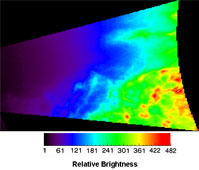
On July 8, 2007 the cameras on
the AIM satellite took this exciting picture of noctilucent
clouds over the North Polar region. These data (see scale:
red being bright) reveal for the first time very bright but
spatially small (~20 to 30 km in diameter) polar mesospheric
clouds that rise in brightness significantly above the background
cloud deck (green and blue). These small, bright clouds have
never been observed before and are the result of complicated
dynamics in the 80 km region of the atmosphere.
Credit: Cloud Imaging and Particle Size Experiment
data processing team at the University of Colorado’s
Laboratory for Atmospheric and Space Physics.
06.11.07

Click image to enlarge.
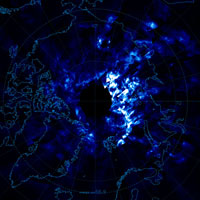
On June 11, 2007 the cameras on the AIM
satellite returned some of the first data documenting noctilucent
clouds over the Arctic regions of Europe and North America.
This new data reveals the global extent and structure of these
mysterious clouds, to a degree that was previously unattainable.
White and light blue represent noctilucent cloud structures.
Black indicates areas where no data is available.
Press
Release about this image.
Credit: Cloud Imaging and Particle
Size Experiment data processing team at the University of
Colorado Laboratory for Atmospheric and Space Physics
|